The IP gold rush: Why everyone wants a piece of India’s microdrama market?
From legacy TV libraries and digital storytelling platforms to studios and OTT players, a new wave of partnerships is turning microdrama IP into a strategic content asset
 by
by
Published: Sep 25, 2026 9:26 AM | 6 min read
 Follow Us

- India's microdrama sector is rapidly evolving, with major media companies forming partnerships to adapt and monetize existing intellectual property (IP) into short-form content, indicating a shift in content consumption patterns.
- The market for microdrama has shown significant growth, with annual recurring revenue estimated to have doubled from $125 million to nearly $260 million within a year, driven by high viewer engagement and the increasing popularity of online video content.
- Established companies are leveraging existing IP to create microdramas at lower production costs, allowing for faster cycles and experimentation with a larger number of stories, while new players like Pratilipi are capitalizing on their extensive libraries to generate audience-validated narratives.
- The evolving ecosystem is reshaping the relationships between IP owners, producers, and distributors, with a trend towards specialization in the production and distribution of microdrama content, raising questions about the sustainability and creative depth of the format.
For a format built around stories that can unfold in minutes, India's microdrama business is beginning to create a much bigger contest over intellectual property.
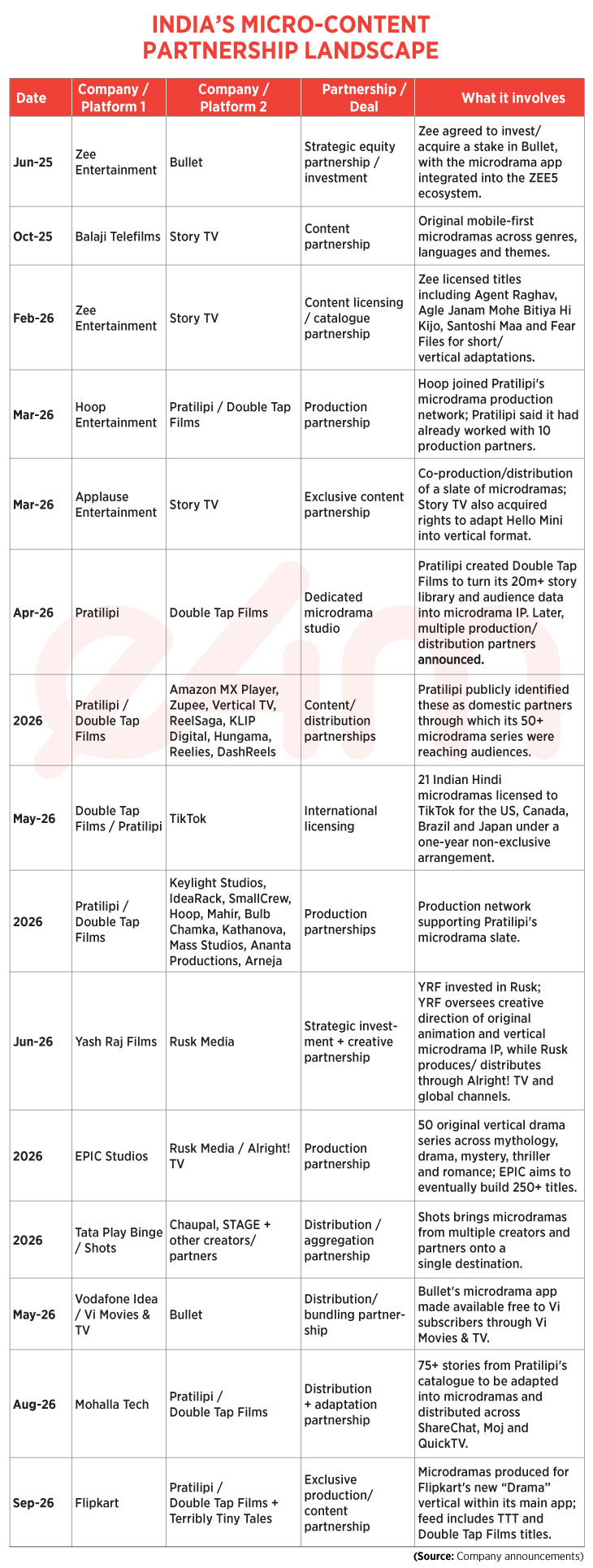
Over the past year, some of the country's established media and entertainment companies have moved beyond simply experimenting with vertical storytelling. Zee Entertainment has partnered with Bullet and Story TV; Balaji Telefilms and Applause Entertainment have entered content alliances with Story TV; Yash Raj Films has invested in Rusk Media; and Pratilipi has created a dedicated microdrama studio, Double Tap Films, to convert its vast storytelling library into short-form IP.
These deals point to an even wider opportunity. Mohalla Tech is working with Double Tap Films to adapt more than 75 Pratilipi stories for distribution across ShareChat, Moj and QuickTV, while Flipkart has entered the category through a new Drama vertical featuring content from Pratilipi's Double Tap Films and Terribly Tiny Tales.
The pattern is becoming clear: microdrama is no longer just another short-form content format. It is becoming a new way to extend, test and monetise IP.
And as more platforms enter the category, the strategic question is shifting from who can produce microdramas to who controls the stories that can keep being adapted, distributed and monetised.
The market is already showing signs of scale. RedSeer Strategy Consultants estimated that India's microdrama category doubled from roughly $125 million in annual recurring revenue in September 2025 to nearly $260 million by November 2025.
ShareChat and Moj's Kantar-backed study has also pointed to high-frequency consumption, with 86% of viewers spending more than 15 minutes watching microdramas daily and 54% returning for another session.
No surprises that online video content grabbed 46% of India’s content investment versus 42% for TV, as per Media Partners Asia’s latest report.
Also Read: How microdrama is redefining premium advertising
How microdramas are rewriting content economics, cost structures
Microdramas move up the value chain as top studios bet on vertical storytelling
Old IP is finding a new screen
Microdrama's attraction for established content companies is partly economic, but IP may be the bigger opportunity.
Earlier e4m reporting found that vertical dramas can be produced at a fraction of the cost of conventional OTT originals, with per-episode costs in the range of Rs 20,000-50,000 in some production models. Faster production cycles and mobile-first distribution allow platforms to experiment with a much larger number of stories without making the kind of upfront bets associated with long-form originals.
That makes existing IP particularly valuable. Zee's licensing of properties including Agent Raghav, Agle Janam Mohe Bitiya Hi Kijo, Santoshi Maa and Fear Files to Story TV for short-form adaptations illustrates one route: taking familiar stories and characters into a mobile-first format.
Applause Entertainment's partnership with Story TV, including the adaptation of Hello Mini, represents another. Instead of treating microdrama as an entirely separate content universe, established IP can be reworked for a different consumption pattern.
For broadcasters and studios, the attraction is straightforward: the underlying story has already been developed, while the vertical format provides another window into that IP.
But the reverse model may be even more significant. Pratilipi has built Double Tap Films around a library of more than 20 million stories and over two million authors. The company says those stories generate more than 800 million reads every month, giving it a substantial pool of audience-validated narratives before production begins.
Ranjeet Pratap Singh, Co-founder & CEO, Pratilipi, said: “India has always been a country of storytellers. What has changed is the screen.” That shift could be central to the next phase of the category. Instead of starting with a blank page, studios can identify stories that have already generated engagement, adapt them for vertical video and use audience behaviour as an early signal of their potential.
Filmmaker and founder of Flying Dreams Entertainment Kushal Srivastava, who recently produced and directed Operation Safed Sagar for Netflix, opines. “IP is obviously the most important part of our business. As a filmmaker I feel when I make something without having IP share, I am just doing a job as a vendor. Having a share in IP means real business, especially in theatrical it’s like having physical property. Both will keep giving returns to you and your next generations.”
He adds that it's all more important when you make good stuff. Srivastava says, “One project’s IP is like a franchise. And a sequel is like making something which already has the audience for it. It makes your job easier. The possibility of going wrong becomes very less.”
This is changing the fundamental economics of content development. The value of microdrama may not lie only in the individual episode. It could lie in the ability to discover the next scalable IP at relatively low cost.
The new IP value chain
The emerging ecosystem is also changing the traditional relationship between IP owners, producers and distributors.
YRF's strategic investment in Rusk Media is one example. YRF will oversee the creative direction of original animation and vertical microdrama IP, while Rusk brings production and distribution capabilities through Alright! TV and its global digital channels.
Similarly, EPIC Studios and Rusk have partnered on original vertical drama series spanning mythology, drama, mystery, thriller and romance, with the stated ambition of building a much larger library of owned vertical-drama IP.
Aditya Pittie, Managing Director, The EPIC Company, said: “A slate of 50 original series is just the beginning. We aim to take the library beyond 250 titles by the middle of next year.”
The model suggests that the next phase of microdrama may not be dominated by companies trying to own the entire stack.
Instead, different players can specialise. One company can own the stories. Another can produce them. A third can provide distribution. Pratilipi's partnerships illustrate this particularly well. Its Double Tap Films business has brought together multiple production houses, including Keylight Studios, IdeaRack, SmallCrew and others, while its content is being distributed across a growing set of platforms.
The result is a more fluid IP economy in which a story can move through several businesses before reaching the consumer. If production becomes increasingly commoditised, the defensible asset may move upstream towards IP, audience data and the ability to identify stories that can generate repeat consumption.
This is also why traditional studios may be looking at microdrama differently from specialist apps. A successful vertical series can potentially become a longer-form property, while established IP can be repackaged for a new generation of mobile-first viewers.
But whether volume can actually produce durable IP remains an open question.
Yubraaj Bhattacharya, Filmmaker, opined that he had not seen serious money being spent on the format at the level required to attract top creative talent. “If that happens then yes, microdrama as a genre can take off,” he had said, questioning whether the current production model is driven more by availability and volume than creative ambition.
That tension — between scale economics and creative depth — could determine which of today's microdrama properties survive beyond the short-form cycle.
Read more news about Digital Media, Internet Advertising, Marketing News, Television Media, Radio Media
For more updates, be socially connected with us onInstagram, LinkedIn, Twitter, Facebook, YouTube & Google News